The Human Rights Situation in Brunei

Based on these news articles:

• Tan, Y. (2019, April 3). Brunei implements stoning to death under anti-LGBT laws. In BBC News. Retrieved from https://www.bbc.com/news/world-asia-47769964*/

• Lamb, K. (2019, April 3). Brunei brings in stoning to death for gay sex, despite outcry. In The Guardian. Retrieved from https://www.theguardian.com/world/2019/apr/03/brunei-death-by-stoning-gay-sex-adultery-sharia-law


Legalizing same-sex marriage is a hotly debated issue. Some are all for same-sex marriage while others do not agree to it, but both sides agree that homosexuality exists. The LGBT+ are already deprived of the right to marry but in Brunei, they are also denied the right to exist in the first place. Homosexuality was already illegal in Brunei. Anyone convicted for homosexuality will be imprisoned for 10 years. Recently, their government passed a law that homosexuals will be sentenced to death by stoning.

According to Ms. Yvette Tan of BBC News, this new law also sentences rapists, adulterers, thieves, and those who vilify Prophet Muhammad. Male homosexuals who engage in anal sex will be stoned, but female homosexuals will be whipped 40 times. Thieves will have their hands and feet amputated. What these 4 have in common is that they hurt another person. They have victims. To include homosexuals to that list is ridiculous. You do not hurt another person simply because you prefer to date another person of the same sex.

The United Nations said that the revised penal code was a “serious setback” for human rights because it was “cruel, inhuman, and degrading.” Another international response was from George Clooney, a famous Hollywood actor. His call for a boycott of nine luxury hotels linked with Brunei was supported by many people all over the world.

George Clooney. Source: The Washington Post

According to Ms. Kate Lamb, a reporter from The Guardian, this new law makes Brunei the first ever country in Southeast Asia to implement a sharia penal code.

Kate Lamb also reported that Tim Lindsey, a specialist on Sharia Law in Southeast Asia at Melbourne University said:

“The [Sharia Code] is not a product of popular demand,” and added “This is a direct, top-down creation, it is something the sultan has pushed extremely hard for over decades. His political legitimacy relies to a great extent on his displaying Islamic credentials.”

Professor Tim Lindsey. Source: law.unimelb.edu.au

Moreover, it was only posted on the attorney general’s website last December 2018 with no public announcement. The citizens did not know there was a new law because, realistically, not everyone opens the website daily. The people were not consulted.

In an interview with BBC News, Shahiran S Shahrani Md said:

“The gay community in Brunei has never been open but when Grindr [a gay dating app] came that helped people meet in secret. But now, what I’ve heard is that hardly anyone is using Grindr anymore” because “They’re afraid that they might talk to a police officer pretending to be gay. It hasn’t happened yet but because of the new laws, people are afraid.”

This shows that it breeds a culture of fear instead of a culture of respect for the law. This makes us ask the question: is this law for the people, or against the people? The weapon of terrorists is fear, but the weapon of proper governance is respect.

Fight Fake News with Fake News

Based on this news article: Kalvapalle, R. (2019, March 30). April Fools’ hoaxes could help researchers build algorithms to better detect fake news. In Global News. Retrieved from https://globalnews.ca/news/5113888/april-fools-fake-news-study/


In an era of fake news, talking about the continued existence of April Fools is important. It is the one day per year when we are excused for lying because “Hey, it was only a practical joke. Lighten up.”

April Fools Day is one of those holidays that we celebrate every year but are not really sure why we do.

I mean, who wants to celebrate being fools? Apparently, we do. According to History.com, April Fools Day has many origin stories. The most famous one can be traced as far back as 1500s France. In 1582, France changed their calendar to Gregorian. The story was that some people were not updated with the news and still celebrated New Year’s Day during the last week of March until April 1, the start of their original calendar.

They became the laughingstock of France and other people pranked them. One prank, in particular, involved sticking paper fishes on their backs. It was a symbolism comparing these people to fishes who are easily baited and caught. And then people of the future (yes, I mean us) continued on the tradition of pranks, this time, not limiting ourselves to paper fishes.

Even professional websites, news stations, and businesses participate in the traditional of April Fools. Here are some examples:

Source: The Guardian

Source: Facebook

In a Global News article, Rahul Kalvapalle (2019) shared the study of Baron and Edward Dearden of Lancaster University. Their study was about how they made an algorithm to identify fake news.

They analyzed the structure of over 500 April Fools articles online and compared them to fake news stories. Their findings was that the algorithm was 75% accurate in distinguishing April Fools articles and 72% accurate in filtering fake news stories.

I guess there is a reason to light up, after all. With the help of their algorithm, we can give fake news a taste of its own medicine. It’s ironic that the way to stop the spread of fake news is the spread of fake news itself.

References

History.com Editors. (2019). April Fools’ Day. In History.com. Retrieved from https://www.history.com/topics/holidays/april-fools-day

• Kalvapalle, R. (2019, March 30). April Fools’ hoaxes could help researchers build algorithms to better detect fake news. In Global News. Retrieved from https://globalnews.ca/news/5113888/april-fools-fake-news-study/

China’s Debt-Trap Diplomacy

Based on this news article: Zhou, L. (2019, March 25). Ethiopian envoy defends Chinese loans against ‘debt trap’ worries. In Inkstone News. Retrieved from https://www.inkstonenews.com/politics/ethiopian-ambassador-beijing-denies-chinese-loans-are-debt-trap/article/3003162 

———-

Ever heard of the joke “If you don’t want to see someone, let them borrow some money and you won’t see them forever”?

China took this up a notch: “If you want a piece of their land, let them borrow some money you know they can’t pay back on time.”

When it comes to countries, if Country B (lendee) cannot pay back the loan + interest in time, they try to negotiate a new schedule or system for repayment with Country A (the lender).

It’s common practice for a country unable to meet the terms of an existing loan to try to renegotiate a new repayment schedule or new financing system.

Sri Lanka borrowed money from China, and they used that money to build infrastructures. Due to that, Sri Lanka was thriving. But as the deadline approached and the interest caught up to them, Sri Lanka struggled to pay back the loans.

They also planned to build a second major port. Officials questioned the plan because they already had major port in the capital. The second port was built in Hambantota, but unfortunately, the only major thing about it was being a major failure.

So they gave China control of the port.

“I told you so.”
— Probably the scholars that studied it and concluded that it would  not be an economic success

Port

Source: The Diplomat

China would say otherwise because the Hambantota port is geostrategically valuable for China in its plan to create a modern-day silk road.

Hambantota

Source: Eurasian Business Briefing

Other countries that also borrowed money from China are Egypt, Kenya, Kazakhstan, Pakistan, Malaysia, Papua New Guinea, Maldives, Laos, and the Philippines.

We cannot say for sure that building a new silk road really is their long-term plan, but take a look at this map:

Debt Map

Source: news.com.au

It looks suspiciously so.

This is a smart move by China. However, for countries that are not sure they can pay back the loans, the smart move would be to not borrow at all… or risk part of their territory taken away.

———-

Notes

*Back in my hometown, the original Bisaya phrase to this is “Kung naa ka’y tao nga di ganahan makit-an, pautanga sija.”

———-

Further Reading

Fernando, G. (2018). China wants to conquer the world, and several countries are now swimming in debt to it. In news.com.au. Retrieved from https://www.news.com.au/finance/economy/world-economy/china-wants-to-conquer-the-world-and-several-countries-are-now-swimming-in-debt-to-it/news-story/a8c743bd7021187e73817d59ca48cb6b

The Christchurch Shootings and What it Means for NZ’s Gun Laws

Based on this news article from CNN: https://edition.cnn.com/asia/live-news/new-zealand-christchurch-shooting-intl/index.html

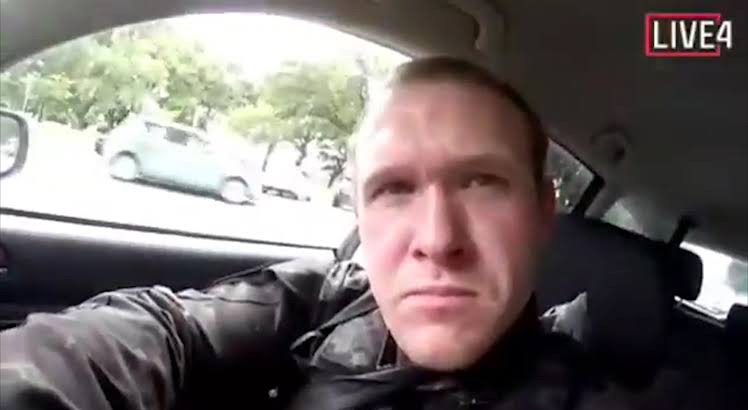
During the recent Christchurch massacre in New Zealand, 50 Muslims were killed and another 50 were wounded. The massacre was broadcasted worldwide through a live video the killer himself posted on Facebook.

(Source: https://images.app.goo.gl/visDBWQM92C1MYBJ9)

Who would do such a thing? Apparently, a guy named Brenton Harrison Tarrant (yes, that’s him in the picture above). But the deeper question is not who but why. Why did he do it? What was the motive of the crime? He could not have just killed people for fun or to get Facebook likes.

When the police were looking for evidence, they found an 87-page manifesto in his house. The manifesto detailed anti-Muslim and anti-immigrant sentiments. This happening makes us realize that even a small, peaceful country like New Zealand is not immune to racism.

According to Andrea Vance of Stuff.co New Zealand, Prime Minister Jacinda Ardern confirmed that the killer used five weapons in total. Due to these killings, the Prime Minister, along with Police Minister Stuart Nash declared that the government will now be banning semi-automatic guns and assault rifles.

(Source: https://images.app.goo.gl/CwLMWmdJEfZwiMG17)

Kate Lyons reported that 37 firearms have been surrendered to the police a few days after the incident. John Hart from the Greens party said that for him, “… it became that trade-off: is my convenience worth the risk to other people’s lives by having these guns in the country? I pretty quickly [realized] there was no comparison. We’ll cope without semi-automatic weapons, we won’t cope without the people who were taken from us from these events.”

The main reason why people buy firearms is so that they can protect themselves. However, buying firearms to protect ourselves from firearms is the wrong way to go about things. It perpetuates a culture of violence as a response to violence. Doing so does not actually protect us. It only means that more people have, well, more firearms. An eye for an eye only makes the world go blind, after all.

Many civilians around the world also own unregistered firearms. The scary thing about this is if the gun will be held by the wrong hands and used for bad intentions, such as what recently happened in New Zealand.

On the academic side of this issue, Dr. Hera Cook said, “When guns are registered, owners then become accountable for each firearm that they own.”

Personally, I am glad for the Prime Minister’s decision on the gun ban. Of course, it’s sad to see that it took a tragedy for the government to decide on banning dangerous firearms, but at least the first step has been taken.

References

• Lyons, K. (2019, March 19). Christchurch shooting: gun owners begin to hand in their weapons. In The Guardian Retrieved from https://www.theguardian.com/world/2019/mar/20/christchurch-shooting-gun-owners-begin-to-hand-in-their-weapons

• Vance, A. (2019 March 21). Christchurch mosque shooting: Police question Auckland gun store as part of weapons investigation. Retrieved from https://www.stuff.co.nz/national/christchurch-shooting/111460338/christchurch-mosque-shooting-police-question-auckland-gun-store-as-part-of-weapons-investigation

Should we “kill” death penalty?

Based on this news report from Al Jazeera: https://www.aljazeera.com/news/2019/03/death-penalty-examined-belgium-forum-190301133042262.html

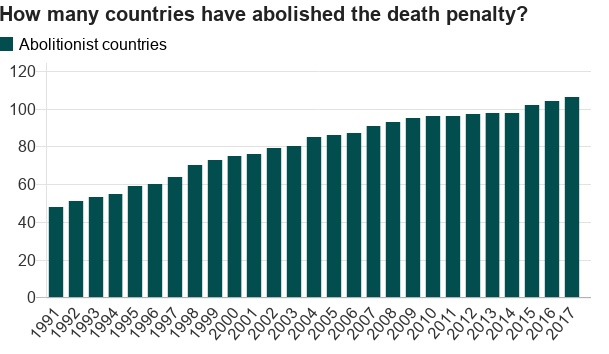
Most of the world has already, so to speak, “killed” death penalty. According to António Guterres, around 170 states have “either abolished the death penalty or introduced a moratorium on its use.” Amnesty International also reported that a total of 142 countries have formally put an end to death penalty. The trend of ending death penalty is rising, as seen in this graph:

(I got this graph from BBC, but the original source is Amnesty International)

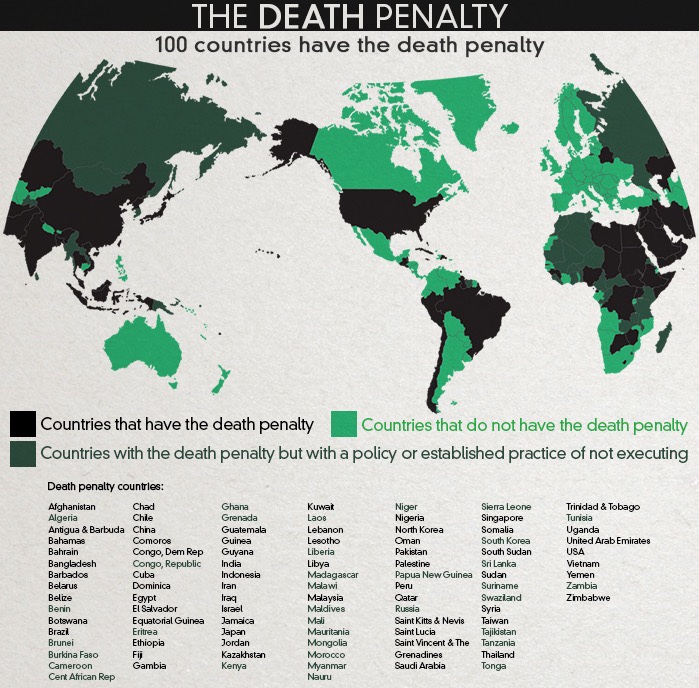
The United Nations has 195 member and observer states. 102 have formally discontinued the use of death penalty, 6 have kept it for “special circumstances,” 51 have not used it for at least 10 years but still have it in their laws, while the remaining 36 still use it:

(Source: Amnesty International, Hands Off Cain, Cornell University Law School)

One of those states include Egypt. During the March 2019 Belgian Forum, Egypt’s President Abdel Fattah el-Sisi publicly supported death penalty, stating that other countries should not force it to change their ways because Egypt has a “different culture” than them.

/Source: https://images.app.goo.gl/Nscjr2L3YGdw5HYq5/

But does death penalty really deter crime? Let’s check in with history.

In 2004, US citizen Cameron Todd Willingham was executed in Texas for killing his three daughters. After his execution, the police found evidence that Willingham did not kill his daughters, after all. However, it was too late. How can you release a wrongfully accused prisoner when he is already dead? The purpose of death penalty is to deter crime and deliver justice; but in this situation, it failed in both. The real criminal escaped punishment; and the execution was an injustice to Willingham who lost his life, and to the three children who have lost their father.

A survey by the American Criminology Society measured that 88% of criminologists agree that death penalty does not “add a significant deterrent effect above that of long-term imprisonment.”

Professor Zimring from Berkeley School of Law, Professor Fagan from Columbia Law School, and Professor Johnson from University of Hawaii made a comparative study of Singapore (which has death penalty) and Hong Kong (which does not have death penalty after they abolished it in 1993).

They concluded that “homicide levels and trends are remarkably similar in these two cities over the 35 years after 1973…”

The truth is that there is no justified way to kill. As put by the Amnesty International’s Deputy Director for the Middle East and North America:

“All executions violate the right to life. Those carried out publicly are a gross affront to human dignity…” — Hassiba Hadj Sahraoui

Public executions imply that murder is justifiable because “the government does it too, why can’t we?” It also paves the way for revenge and justice-seeking, aka vigilanteism. Instead of discouraging future crimes, it can encourage a cycle of revenge and promote apathy to the loss of a human life.

Further Reading

• ABC. (2015, May 4). Fact check: No proof the death penalty prevents crime. In ABC.net. Retrieved from https://www.abc.net.au/news/2015-02-26/fact-check3a-does-the-death-penalty-deter3f/6116030

References

• Geo Ilyin. (2018, August 8). Five Reasons to Abolish the Death Penalty. In Amnesty International. Retrieved from https://www.amnesty.org.au/5-reasons-abolish-death-penalty/

• Paul Brennan. (2019, March 1). Death penalty examined at Belgium forum. In Al Jazeera. Retrieved from https://www.aljazeera.com/news/2019/03/death-penalty-examined-belgium-forum-190301133042262.html

• Persis Flores. (2016, May 3). Here’s Why Miriam Santiago Is Pro-Death Penalty. In Says. Retrieved from Here’s Why Miriam Santiago Is Pro-Death Penalty

• Reality Check Team. (2018, October 14). Death penalty: How many countries still have it? In BBC News. Retrieved from https://www.bbc.com/news/world-45835584

Of the populist, by the populist, and for the populist: The Global Rise of Populism

Of the populist, by the populist, and for the populist

Populism is on the rise. A proof of this is has been reported by The Guardian. According to their statistics*, populism is experiencing a recent surge of popularity. From only 300 articles published about it in 1998, it has more than tripled into 1,000 articles in 2015 and almost 2,000 articles in 2016.

According to this graph from Jordan Kyle and Limor Gultchin, there are more populists now than there were back in the 1990s:

Number of Countries with Populism in Power Graph.png

A few examples of current political leaders that are famous for being populists are Donald Trump of the United States, Marine Le Pen of France, Rodrigo Duterte of the Philippines, and Thaksin Shinawatra of Thailand.

But what exactly is a populist, and so what if populism is rising? Why should we be concerned about that? A populist, according to experts Cas Mudde and Cristóbal Rovira Kaltwasser, believes that politics is an expression of the will of the people, and that the people should fight the elite that has corrupted government.

However, Mudde and Kaltwasser cleared up that a person is not automatically a populist just because he or she is against the corrupt elite. What labels a candidate as populist is how he or she markets himself or herself as the only possible representative of the people and that the “others” (other candidates) are not and whoever votes for them cannot be counted as “real people”.

Let us take Trump, for example. During his campaign rally, he proclaimed:

“The most important thing is the unification of the people – because the other people don’t mean anything.”*

Trump campaign.jpg

Recep Tayyip Erdoğan of Turkey said the same thing, albeit in different words:

“We are the people,” and proceeded to ask his critics, “Who are you?”*

Image result for recep tayyip erdoğan

Another example is Andrés Manuel López Obrador of Mexico. After losing the 2006 elections, he protested against the results:

“The victory of the right is morally impossible” and said that the “legitimate president of Mexico” could only be him.

Image result for andres manuel lopez obrador

To summarize it into a single sentence: populism has a noble belief (or it makes us believe that they have noble beliefs), however, its problem lies in its anti-pluralism and exclusionary politics.

This poses a problem for democracy because by saying such, they insert seeds of doubt into the minds of the citizens in the existing democratic institutions. They make citizens become discouraged to vote because why will they vote if elections are rigged anyway?

Sometimes, it is true that there is are corrupt elites who manipulate the political climate of a nation, and the populists are right in this regard: the corruption should stop. However, it is also possible that populism has only been used as a strategy to get the votes of the masses. As a consequence,  the problem is the same, only that the “populist” is now part of the corrupt elite, even more so because we cannot differentiate the authentic from the inauthentic because they both use the same words.

Instead of being “of the people, by the people, and for the people,” there is a risk that it will become “of the populist, by the populist, and for the populist.”

Notes

*These statistics only count the articles published by and on The Guardian.

*Example from Jan-Werner Müller’s book titled “The Rise and Rise of Populism”.

*Example from Jan-Werner Müller’s book titled “What is Populism?”

References

  • Gultchin, L. & Kyle, J. (2018). Populists in Power Around the World. In Institute for Global Change.
  • Mudde, C. & Kaltwasser, C.R. (2013). Exclusionary vs Inclusionary Populism: Comparing Contemporary Europe and Latin America. In Government and Opposition 48, no. 2: 147–174.
  • Müller, Jan-Werner. (2017). The Rise and Rise of Populism? In The Age of Perplexity. Rethinking The World we Knew. Madrid: BBVA.
  • Müller, J. W. (2017). What is populism?. UK: Penguin.

Bridges, not Borders: Should the US-Mexico Wall be Constructed?

Building border walls is not a new concept.  Walls have been around as early as 10th century BCE when the first city wall was built around Jericho. These walls were built as the first line of defense in protecting its citizens from foreign invaders.

Jericho Wall

(Photo from imgur.com)

There was also the Hadrian Wall in AD 122, built to close off Britain from barbarians.

Hadrian's Wall

(Photo from History.com)

Arguably the most famous of them all is the Great Wall of China. Started during the 7th century, it took more than 2,500 years to finish. That’s a fairly long time. Generations have come and gone without seeing the wall in its complete glory. It was also reported that around 1 million workers died during the construction process. It was for this reason that besides being considered as the longest wall, it has also been referred to as the “longest cemetery in the world”. 

Great Wall of China

(Photo from The Independent)

Then there was the infamous Berlin Wall, constructed on August 12, 1961. What makes it different from the previous three is that its aim was not to protect Berlin from foreigners, but to prevent citizens living in Soviet-controlled East Germany from defecting to West Germany. Even so, the wall did not stop everyone from trying to escape. Many still tried, some survived, but most have been gunned down — their bodies lay as reminders of what would happen if citizens defected.

Berlin Wall

(Photo from HowStuffWorks.com)

The southern border wall was planned by Trump to act as a barrier between Mexico and the United States. Using his own words, it will be built in order to stop “Invasion of our country with drugs, with human traffickers, with all types of criminals and gangs.” With how the wall is marketed to the public, it would seem that it is a defensive move — to protect America from foreigners in the same way that the historical walls did.

Trump Singing National Emergency | Photo from Sara Sanders

(Photo from Sara Sanders)

However, the people he is trying to “protect” the United States from are not barbarians, not foreigners planning to invade the United States, and definitely not the armies of other countries. They are immigrants. Let’s face it, if they were planning to invade, it would be a suicide mission. Everybody knows that the military power of the US is the strongest of all countries. Nobody would want to invade America unless they had a death wish.

Trump’s wall is estimated to cost $8 billion. No matter which angle we look at it, that is a big amount of money. Since the US has that much money in the first place, why can’t it be used to improve healthcare and education? Eradicate poverty? When you eradicate poverty, you lessen the crime rate. That’s a win-win. Instead, it will be used to build a wall.

Another point to consider is that the wall will be bad for the economy. Not only the US economy, but also the economies of other countries who trade with the US  goods, but especially those who import cheap labor. Trump said the immigrants are hurting the economy, but statistics show that the US economy is actually growing. According to Citi Global Perspectives and Solutions, the immigrants are directly responsible for ⅔ of the economic growth. The migrants go to the US to find more job opportunities that pay better compared to the countries they were from. With Trump’s immigration policies, migrants will be afraid of moving to the US, and predictably, the economy will be hurt in the process.

Trump said that the wall can help improve the security of America and the safety of American citizens. However, data shows more Americans have been killed by right-wing extremists than by Islamist terrorists. The roadmap to peace is connection with others, not separation from them. That only evokes fear, which produces distrust, and paves the way for violence. The old adage still stands, after all. Instead of building walls, we should put more effort into building bridges.

To end this, I’ll leave you with three comic strips (thanks, Google) to contemplate on:

This slideshow requires JavaScript.

Sources and Further Reading

Are Trans Women “Women”?

The recent Miss Universe pageant was iconic because it was the day that Angela Ponce made history by being the first ever transgender contestant in the pageant. In its entire 66-year history, the pageant surprisingly reversed a longstanding policy in 2012 pushed by then-owner Donald Trump that participants must be “naturally born” women.

Angela Ponce

There was even a controversy that President Trump’s administration is thinking about pushing laws to block transgender people from military service.

Angela Ponce being allowed to participate in the pageant opened up a universal discourse on transgender rights. To some, it was a pleasant surprise. Angela Ponce was welcomed with loud applause everytime she went onstage. To others, it was a “revulsion” of the pageant. People posted on social media that Miss Spain did not deserve to be in the pageant because she was not a “real woman.”

This was what Miss Spain had to say about it:

“Simply for us all to understand that we are human and that we must make all our lives easier together. That reality for many people is going to change. If I can give that to the world, I don’t need to win Miss Universe, I only need to be here.”

One step for Angela Ponce, one giant leap for humankind.

The crowned Miss Universe, Catriona Gray of the Philippines, showed her support for Miss Spain by saying in a TV interview on The Bottomline, “I’m open to it, because individually, I see beauty queens more than a physical aspect. We represent something — that has to be what we’re there for. And she has a purpose. She is that voice for the transgender community.”

Cat and Angela

When Agence France-Presse asked Ponce about how President Trump pushed the policy on banning transgenders from the pageant, she replied, “I always say: having a vagina didn’t transform me into a woman. I am a woman, already before birth, because,” she continued while pointing at her head, “My identity is here.”

Besides the pageant stage, another area where trans women are discriminated is in the sports field. When talking about sports in a gender light, the first question to ask would be: Why do we still divide sports into men and women categories when both are equal?

The most common argument for that is how men and women may be equal, but can never be similar. Men and women are just simply, point blank, no-doubt-about-it not physically equal.

Let’s look at the Science to settle this debate once and for all. According to a study by MacDougall, Miller, Sale, and Tarnopolsky about the differences in physical strength and muscle fiber characteristics between men and women, they found out that men have a natural physical advantage that would make competetive sports unfair to women.

Their research has shown that women are approximately only 52% as strong as men in the upper body and only 66% as strong as men in the lower body.

So here comes the interesting part. If we consider trans women as women, is it fair when trans women compete in sports in the female category?

Some people would argue, “No, it is not fair because a trans woman is physically a man — bigger, stronger, and not women.”

To say such a thing is to not know what makes a trans woman different from a man.

We always fear what we do not understand, so let’s get educated together, courtesy of Rachel McKinnon who is a trans athlete herself.

Rachel McKinnon

In an interview with Alistar Mogawon of BBC Sport, McKinnon explained that before and after transition, trans women would take the testosterone-blockers along with the female hormone oestrogen. She also revealed that due to her transition, her muscle mass and strength were both reduced.

In addition to that, according to McKinnon, before being able to compete, trans athletes have to undergo a test that measures the amount of testosterone in their bodies before they can be allowed to play. This is because there are set limits, and if they fail the test, they will be disqualified from competing.

This shouldn’t be a question of “Can trans women participate in sports?” but a question of “Should our current laws on competitive sports be reviewed and updated?”

I am a small person, and my sport was chess from Elementary to High School. In College, I also joined physical sports such as soccer, badminton, and basketball. What I have observed was that even when playing with strictly cis females, there was still a huge difference in height and strength between the players.

Taller and bigger women are allowed to compete against shorter and smaller women, and we still call that “fair”. In fact, the difference in height and strength between men and women is not so different from the difference between men and other men, and women with other women.

Maybe the talk of how men are stronger and women are weaker is due to the traditional standard of telling women not to lift weights or work out hard because it will make them “grow unattractive muscles” while men are encouraged to work out extra hard and lift heavier weights because they have been told that more muscles will make them attractive.

Telling a woman that she cannot do something just because she is a woman is dicrimination, and telling someone repeatedly that he or she should not do something because of their gender is oppression. This only further proves how hard women have been oppressed for centuries. When you look deeper into it, men have been oppressed too, albeit in a different way. I mean, can you believe that men are discouraged to cry, cook, clean, along with other activities that are considered to only be “for women”?

The International Olympic Committee’s charter has seven fundamental principles of Olympism, and their fourth principle states, “The practice of sport is a human right.” To not allow trans women to compete merely because they are trans is depriving them of this human right, and alienating them even further from society.

In the side of the law and legal procedures, one of the dangers of not considering transgender and transsexual women as women is that they would not be protected by gender-related laws, such as when they become suspect to a crime. Since she will be technically considered as a man, a male police officer will legally be allowed to touch and search her. Also, if she will be considered as a man, then she will be forced to use the men’s bathroom — where she is in danger of being verbally abused or disrespected.

Nevertheless, whatever side of the debate you are on, what we can all learn from Angela and Rachel is that we should not let society tell us what we can and cannot do in the same way that we should not let others tell us who we can and cannot be, because only we know what we can do, and only we can control our identity.

Let me leave you with a homework: when asked whether you are a lover or a fighter, do not answer one or the other. Be both. They are not mutually exclusive. You can fight for love just as you can love to fight for what you believe in. Another thing we can learn from them is that when we believe in something, we should not be afraid to stand up for it.

The underlying issue here is that we do not really know how to communicate well to one another. We find it hard to listen and empathize, which is how wars typically start. If you believe that trans women are women, comment below. If you believe that trans women are not women, comment below too. Because only through discourse, not force, can we ever solve our problems.

—————————————————————–

The News and the Science (References and Further Reading)